ARIKAYCE targets MAC at the site of infection1-3

MAC can persist in biofilms or intracellularly within macrophages, making MAC lung disease particularly challenging.4

mac can persist in biofilms or intracellularly with macrophages, making MAC lung disease particularly challenging

Challenges to treating MAC include the need for4:

  • Effective delivery and distribution of high amounts of antibiotics to the lungs
  • Penetration of biofilms and macrophages to reach the sites where MAC lives and replicates
  • Limited systemic exposure

Amikacin exhibits concentration-dependent bactericidal effects in vitro but accumulates poorly in cells.

ARIKAYCE was developed to penetrate biofilms and kill MAC1,3-5:
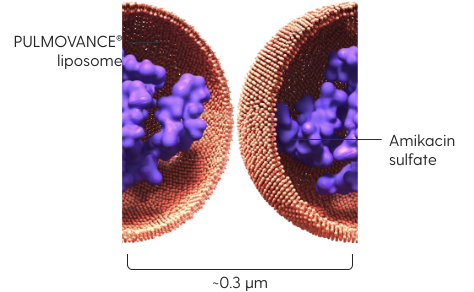
amikacin liposome inhalation suspension and pulmovance technology

ARIKAYCE delivers1,4:

  • Liposomal and free amikacin into the lungs through nebulization
  • ~4 times more amikacin into macrophages compared to cells exposed to the same concentrations of free amikacin based on in vitro data from a study of cultured human macrophages
  • 5 to 8 times more amikacin into pulmonary macrophages compared to inhaled free amikacin in animal studies

The clinical significance of these data is unknown.

In the 2018 CLSI guidelines, the MIC breakpoint for resistance is ≥128 μg/mL for ARIKAYCE.6

An amikacin MIC level of ≤64 μg/mL is considered susceptible for ARIKAYCE.6

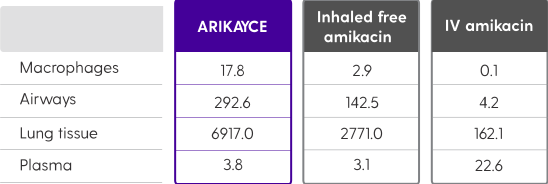
More uptake into macrophages with ARIKAYCE as shown in an in vivo study4

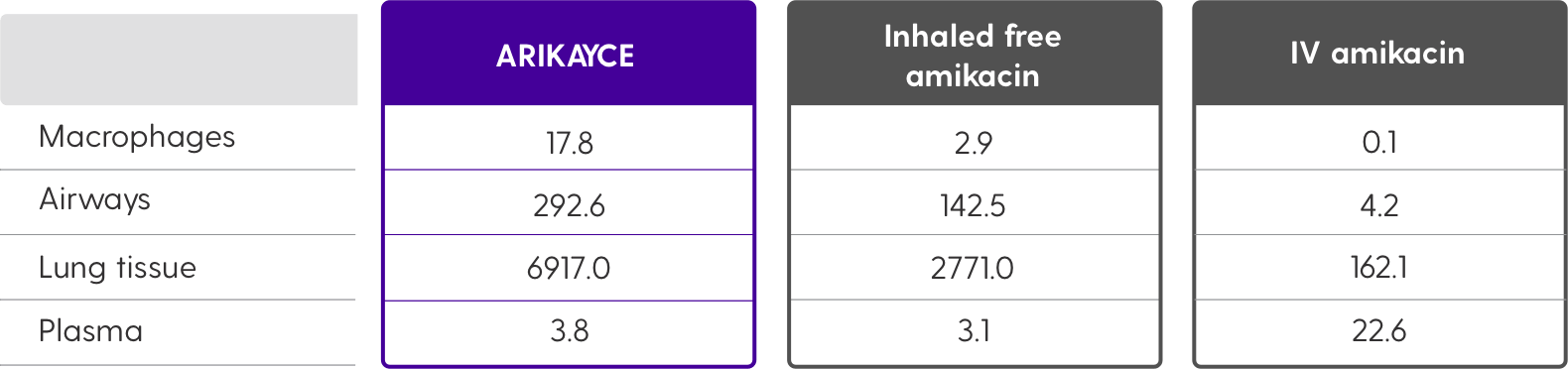
ARIKAYCE in vivo amikacin uptake into macrophages in rats compared to inhaled free and IV amikacin4

Values represent AUC calculated for each group using the mean concentrations at each time point. AUC2-24 was calculated for macrophage, airway, and plasma exposures, whereas AUC0-24 was calculated for lung exposure.4
In vivo study results

Scroll to see full chart. →

In vivo study results
ARIKAYCE Inhaled free amikacin IV amikacin
Macrophages 17.8 2.9 0.1
Airways 292.6 142.5 4.2
Lung tissue 6917.0 2771.0 162.1
Plasma 3.8 3.1 22.6

The clinical relevance of these data is unknown.


Limited systemic exposure with ARIKAYCE1


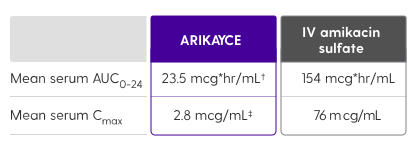
Following 3 months of once-daily inhalation of 590-mg ARIKAYCE in MAC patients, the mean serum AUC0-24 and Cmax were measured and compared with the approved dosage of 15 mg/kg IV amikacin once daily in healthy adults.


Amikacin serum levels were lower with ARIKAYCE vs IV amikacin1*


Scroll to see full chart. →

Mean serum level results
| | ARIKAYCE | IV amikacin sulfate | |--------------------|----------------|---------------------| | Mean serum AUC0-24 | 23.5 mcg*hr/mL | 154 mcg*hr/mL | | Mean serum Cmax | 2.8 mcg/mL | 76 mcg/mL |

The clinical relevance of these data is unknown.


Take an immersive look at how ARIKAYCE targets MAC at the site of infection1-3


How to Use Your Lamira Nebulizer System for ARIKAYCE
  • Place ARIKAYCE vial at room temperature 45 minutes before use
  • It is recommended to use a bronchodilator before using ARIKAYCE
  • Shake ARIKAYCE vial well before opening it
  • Pour ARIKAYCE into the medication reservoir
  • Begin treatment by pressing and holding the on/off button
  • When ARIKAYCE mist begins to flow, insert the mouthpiece and take slow, deep breaths. Then breathe normally
  • Clean handset and aerosol head immediately after use
Transcript

The ARIKAYCE Experience:
Explore How ARIKAYCE Targets MAC at the Site of Infection

INDICATION

LIMITED POPULATION: ARIKAYCE® (amikacin liposome inhalation suspension) is indicated in adults, who have limited or no alternative treatment options, for the treatment of Mycobacterium avium complex (MAC) lung disease as part of a combination antibacterial drug regimen in patients who do not achieve negative sputum cultures after a minimum of 6 consecutive months of a multidrug background regimen therapy. As only limited clinical safety and effectiveness data for ARIKAYCE are currently available, reserve ARIKAYCE for use in adults who have limited or no alternative treatment options. This drug is indicated for use in a limited and specific population of patients.

See the full Prescribing information for ARIKAYCE for information about Limited Population.

Please see Important Safety Information at the end of this video and full Prescribing Information, including boxed warning, available at ARIKAYCEHCP.com.

Hi, my name is Professor Michael Loebinger. I'm a consultant respiratory physician at Royal Brompton Hospital, in London. I’m speaking on behalf of Insmed as a paid consultant.

Welcome to the ARIKAYCE experience where we will explore the lungs of a patient with MAC lung disease to see how treatment with ARIKAYCE works to target MAC and address the challenges associated with treating this disease.

Let’s start by exploring the lung anatomy and how a MAC infection develops.

As you can see, air flows from the trachea through the bronchi into the smaller bronchioles, ending at the alveoli, where gas exchange occurs.

In MAC-infected lungs, nodules and cavities can form at infection sites in the smaller airways.

Let's navigate through one of the bronchi and examine an infection site up close.
Inside the lungs, we can see macrophages and MAC biofilms on the internal surfaces of the lungs. MAC can persist within these biofilms and intracellularly inside of macrophages, making it particularly difficult to penetrate and treat with systemic antibiotics.

Let's step away for a moment to take a look at ARIKAYCE and learn how it may be able to help.

ARIKAYCE was specifically designed to target MAC lung disease at the site of infection. ARIKAYCE is a nebulized therapy that delivers a liposomal form of amikacin directly into the lungs.

When ARIKAYCE is inhaled, it's distributed throughout the lobes of the lungs and into the peripheral airways delivering both liposomal and free amikacin. Once inside, the liposome allows ARIKAYCE to penetrate the biofilms and enhances the uptake into macrophages.

Let’s dive back through the bronchi and into the lungs to see how ARIKAYCE works at the site of infection

Here we can see ARIKAYCE moving throughout the bronchi.

In preclinical in vitro studies, ARIKAYCE demonstrated the ability to penetrate dense biofilms, reducing cell count and effectively killing MAC. The clinical relevance of this is unknown.

ARIKAYCE can also penetrate macrophages and treat the infections intracellularly.

Let’s take a look at the inside of the macrophage as ARIKAYCE penetrates.

Inside the macrophage, we can see our target, MAC bacilli. We can also see that ARIKAYCE has penetrated the cell. Although the clinical relevance is unknown, animal studies have demonstrated that ARIKAYCE achieved a 5 to 8-fold higher concentration of amikacin within macrophages vs inhaled free amikacin with similar plasma concentrations. Compared with IV amikacin, ARIKAYCE achieved a 274-fold higher area under the curve for amikacin exposure within macrophages over 24 hours, and a lower systemic exposure.

I hope this experience has demonstrated how ARIKAYCE was specifically designed, with its liposomal formulation and inhaled method of delivery, to target MAC at the site of infection. To learn more about ARIKAYCE and to hear further insights from experts in the field, visit ARIKAYCEHCP.com.

Footnotes

*The maximum Cmax and AUC0-24 were below the mean Cmax of approximately 76 mcg/mL and AUC0-24 of 154 mcg*hr/mL observed for IV administration of amikacin sulfate for injection at the approved dosage of 15 mg/kg once daily in healthy adults.1

Range: 8.0 to 46.5 mcg*hr/mL; n=12.1

Range: 1.0 to 4.4 μg/mL; n=12.1

AUC=area under the curve; CLSI=Clinical and Laboratory Standards Institute; IV=intravenous.

References
1. ARIKAYCE [package insert]. Bridgewater, NJ: Insmed Incorporated; 2025. 2. Griffith DE, Eagle G, Thomson R, et al; CONVERT Study Group. Amikacin liposome inhalation suspension for treatment-refractory lung disease caused by Mycobacterium avium complex (CONVERT): a prospective, open-label, randomized study. Am J Respir Crit Care Med. 2018;198(12):1559-1569. doi:10.1164/rccm.201807-1318OC 3. Data on file. Insmed Incorporated. Bridgewater, NJ. 4. Zhang J, Leifer F, Rose S, et al. Amikacin liposome inhalation suspension (ALIS) penetrates non-tuberculous mycobacterial biofilms and enhances amikacin uptake into macrophages. Front Microbiol. 2018;9:915. doi:10.3389/fmicb.2018.00915. 5. Olivier KN, Griffith DE, Eagle G, et al. Randomized trial of liposomal amikacin for inhalation in nontuberculous mycobacterial lung disease. Am J Respir Crit Care Med. 2017;195(6):814-823. doi:10.1164/rccm.201604-0700OC 6. Woods GL, Wengenack NL, Lin G, et al. Performance Standards for Susceptibility Testing of Mycobacteria, Nocardia spp, and Other Aerobic Actinomycetes. Clinical and Laboratory Standards Institute. 1st ed. CLSI supplement M62. 2018:38(22).